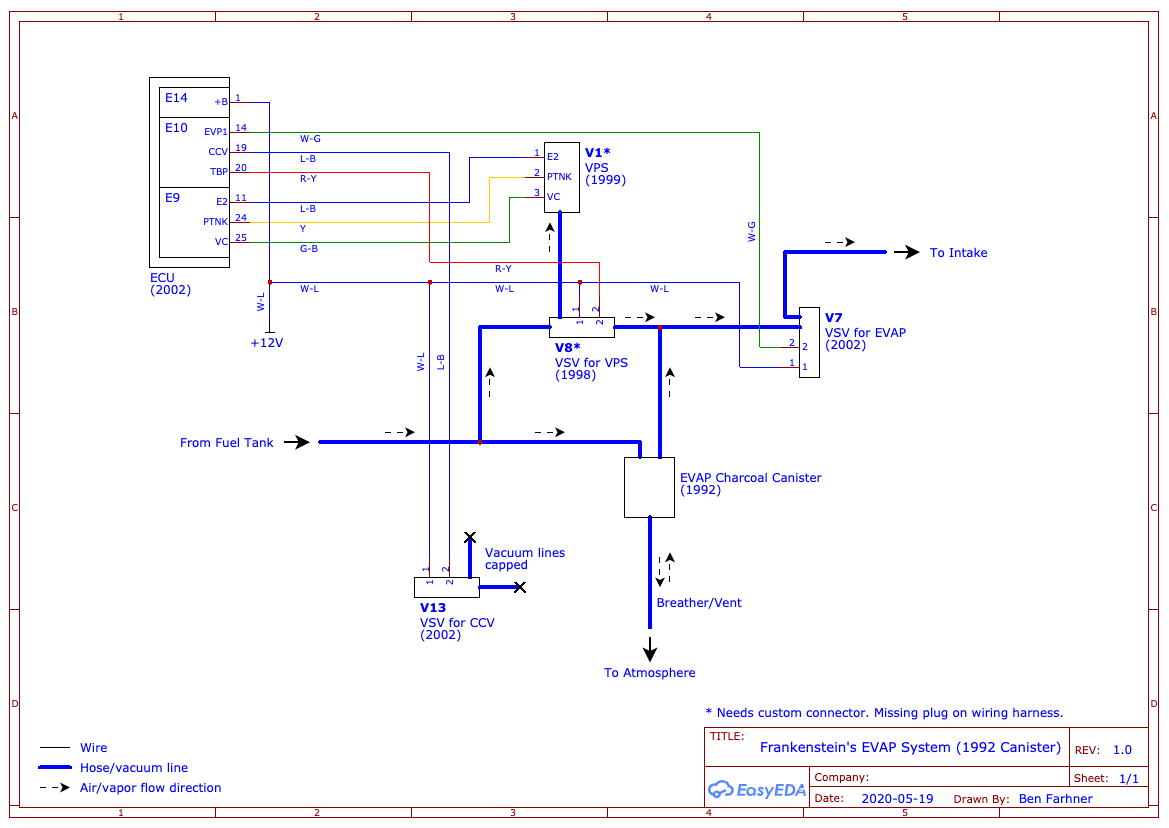
• Frankenstein’s EVAP System, Part 1

    When I did the 3.4 engine swap in my 4Runner, I didn’t pull over the EVAP system from the donor vehicle, so I’ve been running without one for a few months now. My donor vehicle for the swap, a 2002 4Runner, had the newer style EVAP system located back by the fuel tank, something I didn’t want on my ’92. Since then, I’ve acquired the older style 3rd gen EVAP canister and VSVs (Vacuum Switching Valves), and I still have the original ’92 canister, and I’m trying to piece together Frankenstein’s EVAP system from all these parts to work with my swap.

    Parts

    Here’s what I have to work with:

    • 2002 engine wiring harness
    • 2002 VSV for EVAP
    • 2002 VSV for CCV (Canister Closed Valve)
    • 1999 VPS (Vapor Pressure Sensor)
    • 1999 VSV for EVAP
    • 1998 EVAP canister (larger box style)
    • 1998 VSV for VPS (Vapor Pressure Sensor)
    • 1992 EVAP canister (smaller cylindrical style)
    1999 VPS and VSV for EVAP for 3.4 swap
    1999 VPS (left) and VSV for EVAP

    I saw a few places reference the “VSV for EVAP” part as the “Canister Purge Solenoid,” which may come in handy when looking for replacement parts.

    2002 VSV for EVAP and VSV for CCV with hoses for 3.4 swap
    2002 VSV for EVAP (top left) and VSV for CCV (top middle), with hoses

    Process

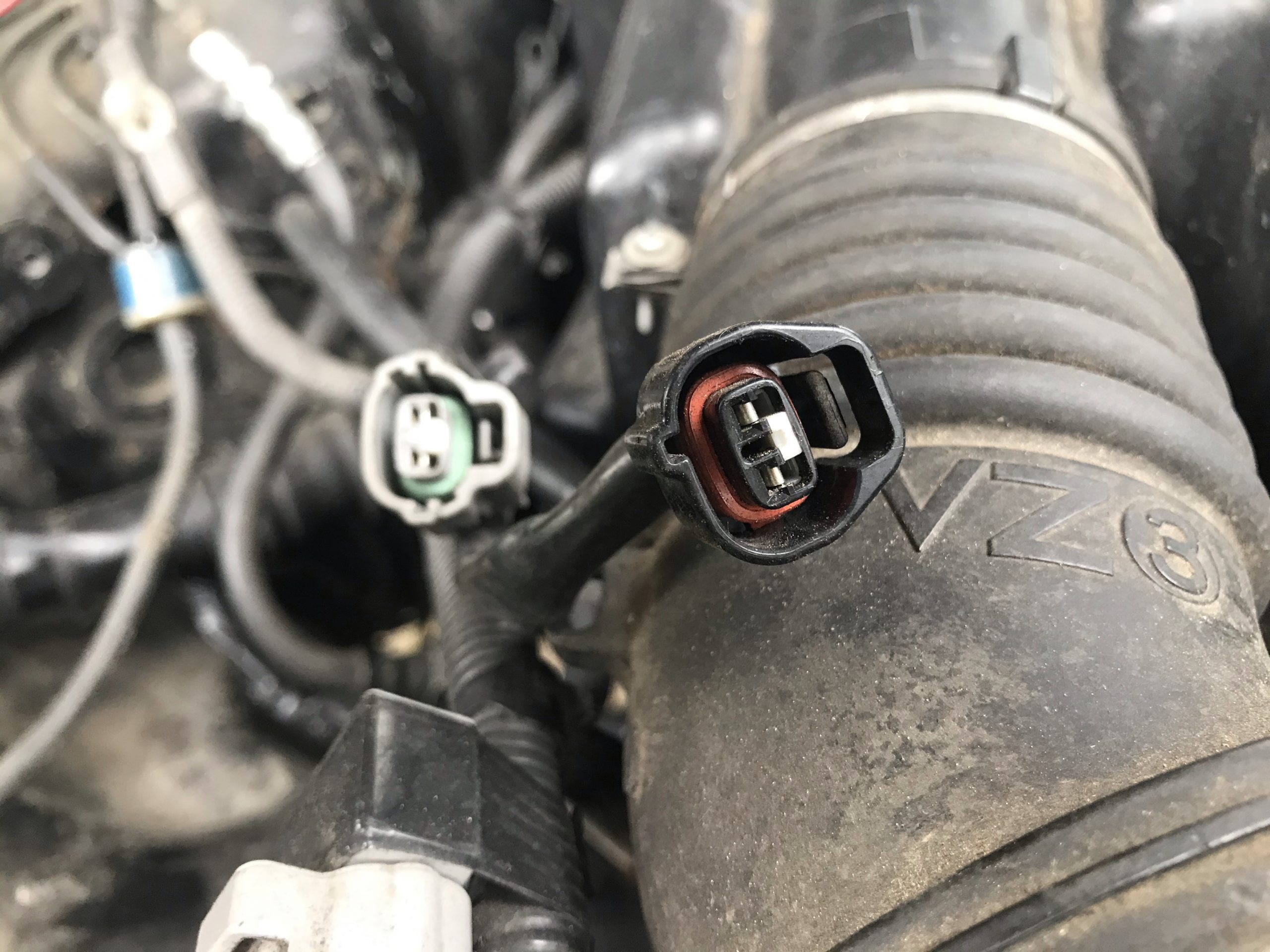
    First, I had to figure out what plugs I had available on the 2002 engine harness to work with. Using the 2002 wiring diagram, I was able to locate the plugs for the VSV for EVAP and the VSV for CCV.

    2002 engine harness plugs for the VSV for CCV and VSV for EVAP for 3.4 swap
    2002 engine harness plugs for the VSV for CCV (left, background) and VSV for EVAP (right, foreground)

    However, the other 2 plugs were part of the body wiring harness on the donor car which I did not keep, so I’ll need to do some extra wiring work to hook up the VPS and VSV for VPS.


    Check out Part 2 as I map all of this out and figure out how to hook it up so my 3.4 swap can have a working EVAP system!

  • CB Radio Install

    I recently installed a CB radio in my 4Runner. It turns out that certain smaller CB radios, like the Uniden PRO520XL that I used, fit perfectly in the ashtray location. I put together a short video on how I did the install, and I’ve included a few extra details below.

    I’m actually running a 4′ antenna, not a 5′ like I said in the video. I also forgot to mention that you’ll probably need a right-angle connector for the antenna on the back of the CB (you can see it when I’m test-fitting the radio) in order to fit inside the dash. Mine is right up against the back with the right-angle connector and there wouldn’t have been enough room without it.

    Parts List:

    Be sure to tune your antenna before you use the radio! The video below has great instructions on how to tune your antenna. For tuning, I used the following additional parts:

  • The Best Way to Buy a House

    I’ll just come right out and say it: the best way to buy a house is with 100% cash. But that’s not really feasible for most people. So what’s the best practical way to buy a house?

    My wife and I bought our first house with a 20% down payment and a 15-year fixed-rate mortgage, and let me tell you, it was hard. We lived with my parents for 3 years while I worked 2-3 jobs to save up that down payment. Especially in the Seattle area, in a rising housing market, getting a 20% down payment is not an easy feat. But I wouldn’t have done it any differently, and here’s why.

    How Much to Put Down

    A big down payment has two primary advantages: it puts immediate equity into your home, and it saves you interest over the life of the loan.

    As of January 2020, the median house sale price in the US is $236,900 (Zillow), the mortgage rate for a 30-year fixed-rate conventional mortgage is 3.70% (Zillow), and the mortgage rate for a 15-year fixed-rate conventional mortgage is 3.16%.

    With no down payment, a 30-year mortgage would end up costing you $155,770 in interest alone! With a 20% down payment on that house, however, a 30-year mortgage would only cost $120,674 in interest, saving you $35,096 over the life of the loan, or over $1,100 per year.

    Why 20%? Because if you put less than 20% down, you’ll most likely need to pay PMI. Private Mortgage Insurance is an extra payment tacked onto your monthly payment that banks use to hedge their bets on your loan, which doesn’t go towards your home equity. By putting at least 20% down, you can avoid giving the bank extra money!

    Why Get a 15-year Mortgage?

    Following the example of the median house in the US, while 20% down on a 30-year mortgage would cost $120,674 in interest, a 15-year mortgage would only cost $48,717 in interest! That’s a savings of $71,957—not an insignificant chunk of change!

    You will typically get a lower interest rate with a 15-year fixed mortgage versus a 30-year, and that’s because the banks see it is a lower risk. Current rates as of January 2020 are 3.70% for a 30-year versus only 3.16% for a 15-year. Those percentage points make a big difference over multiple decades!

    As an aside, typically a conventional fixed-rate mortgage is going to best in the long-run. ARM, jumbo, and balloon loans usually end up costing you more in interest. If you can take advantage of a special first-time homebuyer program or the VA loan, though, and keep it fixed-rate and preferably 15-year with a large down payment, then by all means, take the opportunity!

    Mortgage Versus Income

    An important consideration here is that a 15-year mortgage will have a higher monthly payment. Depending on your income, it may not be wise to get a 15-year mortgage if the monthly payment will be too high.

    We are big fans of Dave Ramsey, and he recommends limiting your mortgage payment is no more than 25% of your take-home pay. That’s really hard to do, and we were in the 35% range for a while, which can definitely be a strain on your budget. But we were determined to save in the long run, so we went with the 15-year mortgage, and tightened up the rest of our budget to make it work.

    The Myth of the Credit Score

    A lot of people assume you need to have a credit score to buy a house. That’s actually not true: we purchased our home with absolutely no credit score, and didn’t have any issues. You just have to find a bank that will down a manually underwritten mortgage (like Churchill Mortgage), and provide some additional paperwork to show the bank you can make on-time payments.

    By dispelling this myth, it saves you the hassle of having to manage credit cards, making sure to pay them on time, avoiding debt, hoping your credit score stays high, and hoping the bank gives you a good rate based on your score. Instead, you can focus on working and saving, which is exactly what we did.

    Stewardship and Homeownership

    Buying a house with these principles provides a great opportunity to exercise stewardship in a number of ways. Firstly, by working hard and saving up a large down payment before you purchase, you’re practicing diligence and delayed gratification—both good life skills—as well as good stewardship of your finances.

    Secondly, by putting more down and getting a shorter-term loan, you’re saving on interest and keeping more of your income over the life of the mortgage, which sets you up for building wealth—more good stewardship of finances.

    Thirdly, the house itself will require upkeep, maintenance, possibly repairs or remodels, all things which a good steward of that house will embrace. Whether you work on those projects yourself or hire them out to quality contractors, taking responsibility for the property you’ve purchased to keep it in good shape and to improve it is an excellent way to start building the stewardship mindset.

    Are you thinking of buying a home, or already have? How has your experience been with home buying and homeownership, and how do you think it relates to stewardship?

  • The Stewardship of Stuff: Materialism, Minimalism, and KonMari

    We live in a very materialistic culture, where consumerism reigns and people accumulate lots of stuff. Some of it is good stuff, but a surprising amount of it is usually just junk. Unbridled consumerism can negatively affect many aspects of your life: your finances, your time, your focus and energy, and more. We need a remedy for that.

    I’ve pondered minimalism for a long time as an answer to materialism, although I have yet to fully realize it in my own life. I’ve managed to acquire lots of stuff myself, and every time we’ve moved, I’m baffled by how much stuff comes out of the woodwork. We’ll have a yard sale, donate a few carloads to Goodwill, sell some items online, and then by the following year, have to do it all over again. I suppose that’s the reason for spring cleaning—a process that I actually really enjoy, which is a benefit.

    Practical Minimalism

    In my quest for a remedy to materialism, consumerism, and the accumulation of stuff, I’ve become very interested in the KonMari method, popularized by Marie Kondo in her book The Life-Changing Magic of Tidying Up (2011) and her Netflix show Tidying Up with Marie Kondo. The essence of Marie Kondo’s method is to get rid of anything that doesn’t “spark joy” for you and organize everything that does so it’s in its proper place. I’ve adopted these techniques with some success, particularly with my clothes (including using her method of folding and storing clothes), as well as with other categories of items. When spring cleaning, I also like to evaluate whether I’ve used an item in the last year. If not, I’ll get rid of it, unless it is a special item that “sparks joy” or is something that is only used occasionally, like certain tools.

    It’s useful to leverage natural transition periods to organize and purge your stuff. The classic example is spring cleaning, but each change of season is really a good opportunity to clean house, as some items go into storage and other items come out for use. Practicing this up to 4 times per year means it will go faster each time, too! Marie Kondo recommends going through items by category instead of by room. However, we tend to use a mix—sometimes, going by room makes more sense, such as the laundry room, bathroom, or the workshop.

    For clothing, we’ve started using a modified “capsule wardrobe” method. What this means for us is that during the summer, we’ll store all of our winter-specific items (sweaters, snow pants, gloves, hats, etc.) in a bin under the bed or in the attic; and during the winter, we’ll store all of our summer-specific clothes (t-shirts, shorts, flip-flops, etc.). Year-round items stay in the dresser, as well as multi-season clothes. This helps reduce clutter in the dresser and makes decisions easier when getting dressed because there are fewer clothes to sift through.

    Part of our motivation to continue paring down our belongings is to have a clutter-free house that is more readily available for hosting friends and family. Less stuff means a house that is easier to clean, a home that is more beautiful, and—at least for us—a life that is less stressful. We moved into our current house in one and a half 26-foot moving trucks, but we’re planning on moving out in a single 16-foot PODS container: a challenge we’re actively working towards now.

    Buy It Once

    Rebellion against materialism and consumerism may seem like a rebellion against capitalism, but I actually disagree. I’m a proponent of capitalism when used with restraint and good values. The issues with capitalism come when it is unrestrained, just like consumerism—or anything, really, and focuses on profits over people. Capitalism paired with valuing people over money means that people will be served well by the best companies in a competitive market, instead of people suffering as companies profit in a competitive market. Additionally, companies that focus on quality over quantity will ultimately meet people’s needs better, will leave them more satisfied, and will reduce the amount of stuff that we need (or think we need) to buy and own.

    The concept of “buy it once” is that buying high-quality items means you only have to buy them once in a lifetime because they’re built to last. This usually means the items are more expensive upfront, but because they’ll last so long, you’ll end up saving money in the long run as well as reducing waste. Buying these types of items also helps shape the market, letting companies know that higher quality items are more important to their customers, and it shows good stewardship of not only our personal belongings but of our planet too, through reduced wastefulness. Double stewardship points!

    Just kidding, there are no points awarded. However, I’d love to hear your thoughts on materialism, minimalism, and being good stewards of our stuff. Leave a comment below!

  • What is a Steward?

    The Merriam-Webster dictionary defines stewardship as “the careful and responsible management of something entrusted to one’s care”. As humans, we are each responsible not only for our own lives, but for the lives, well-being, and care of the people, animals, and resources around us. This stewarding of our world is fundamental to the long-term success of society and of mankind on this planet.

    In a weaker sense, being a steward is being a manager. Everything in our lives must be managed—that is a given. However, stewardship implies more care, more seriousness, more intentionality than just managing. I can manage to get through this week, but can I steward those 7 days in such a way that I made the best use of the time, resources, and relationships during that week? It’s a much bigger responsibility.

    In the Judeo-Christian tradition, God made mankind stewards of the earth when He told them in Genesis 1:28, “Be fruitful and multiply and fill the earth and subdue it, and have dominion over the fish of the sea and over the birds of the heavens and over every living thing that moves on the earth.” As a Christian myself, the Bible is the strongest reason I have to practice stewardship, but you don’t have to be religious to be a good steward. There are many environmental, scientific, psychological, and societal reasons to practice stewardship.

    Stewardship is really a mindset that can then be applied to all aspects of life. If we approach everything in our lives—people, finances, food, etc.—thinking, “how can I carefully and responsibly manage this?” then we are well on our way to practicing good, holistic stewardship. My goal with this blog is to share my thoughts, progress, struggles, and successes as I strive to be a good steward, and my hope is that you’ll be encouraged in your journey as well.